Case 4: Polymer Mixture (PEO + LiTFSI)
Case 4: Polymer Mixture (PEO + LiTFSI)
Section titled “Case 4: Polymer Mixture (PEO + LiTFSI)”In this case, we construct a mixed system of Polyethylene Oxide (PEO) and Lithium salt (LiTFSI), which is a representative system for polymer electrolytes.
Target System
Section titled “Target System”- Composition:
- Polymer: PEO (DP 40) × 6 chains
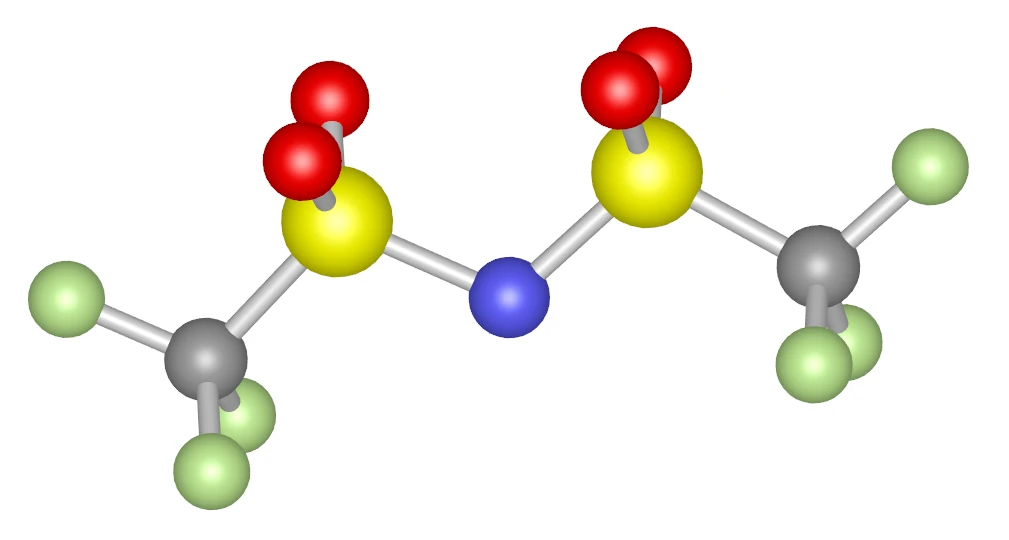
- Salt: Li+ × 40 / TFSI- × 40
- Total Atoms: 2,332
- Initial Target Density: 0.80 g/cm³
Calculation Code (run.py)
Section titled “Calculation Code (run.py)”import fbtk
# 1. Define ionic components (Specify charges explicitly)li = fbtk.Molecule.from_smiles("[Li+]", name="Li")tfsi = fbtk.Molecule.from_smiles("C(F)(F)(F)S(=O)(=O)[N-]S(=O)(=O)C(F)(F)(F)", name="TFSI")
# 2. Initialize the Builderbuilder = fbtk.Builder(density=0.80)
# 3. Add polymerbuilder.add_polymer( name="PEO", smiles="*COC*", count=6, degree=40)
# 4. Add ions (Treat as small molecules)builder.add_molecule(li, count=40)builder.add_molecule(tfsi, count=40)
# 5. Build the system and perform relaxationsystem = builder.build()print("Starting relaxation for PEO + LiTFSI...")system.relax()
# 6. Output resultstfsi.to_file("tfsi.mol")system.to_file("peo_litfsi_cell.mol2")print("Done.")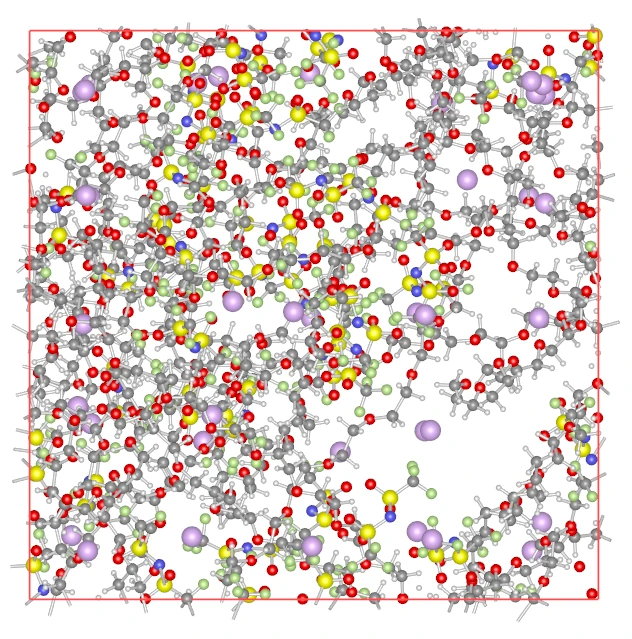
Reviewing the Execution Log
Section titled “Reviewing the Execution Log”Atoms: 2332 | Bonds: 2246-------------------------------------------------------------------------------- | Fmax | FRMS | Total E |Iter | (kcal/mol/Å) | (kcal/mol/Å) | (kcal/mol) | Status-------------------------------------------------------------------------------- 0 | 42460.5967 | 5751.8199 | 1522447504435.8914 | 10 | 6956.8469 | 332.1981 | 283012.9750 | 20 | 2197.2766 | 160.4736 | 162126.0113 | ... 230 | 3498.5209 | 55.5260 | 21639.1823 | 240 | 124.9193 | 2.7596 | 21638.9629 | 247 | 83.1694 | 2.3074 | 21638.9629 | E-Stalled--------------------------------------------------------------------------------=== Optimization Finished ===Reason: E-StalledTotal Time: 4.063s (Avg: 16.382ms / step)Final Energy: 21638.9629 kcal/molFinal Fmax: 83.1694 kcal/mol/ÅFinal FRMS: 2.3074 kcal/mol/ÅMin Distance: 1.0080 Å (Atoms 123 and 126)--------------------------------------------------------------------------------Result Explanation
Section titled “Result Explanation”Handling Ions and Structural Relaxation
Section titled “Handling Ions and Structural Relaxation”In FBTK’s relax() (based on the UFF force field), electrostatic interactions (Coulombic forces between charges) are now considered during relaxation. By explicitly specifying charges in SMILES, such as [Li+] and [N-], FBTK automatically assigns partial charges and uses them to resolve overlaps and electrostatic imbalances during the initial structure generation.
Relaxation Quality
Section titled “Relaxation Quality”The Min Distance is 1.0080 Å, which means that even in systems where ions and polymer chains are densely packed, the system has been relaxed to a state without physically fatal collisions. A standard workflow would be to pass this relaxed structure as an initial value to MD software for rigorous equilibration including electrostatic interactions using a charge-aware force field.